Showing posts sorted by date for query bread. Sort by relevance Show all posts

Thursday, February 22, 2007

Step-By-Step Injera Instructions- The Real Thing!

Get out your sourdough starter and your mitad because it's time to make injera!


Warning: This seems complicated, but after you've done it once or twice, it will become much easier. So don't give up!

After trying and failing to make injera for about a year, I finally was blessed with an Ethiopian woman, Abeba, who has become a very dear friend. Abeba is a wonderful cook and has spent quite a bit of time with me helping me to make injera the way Ethiopians in America make it.

I've made enough successful batches of injera that I now feel comfortable sharing it with my readers. I will give written step-by-step instructions. For the visual learners, I have also uploaded videos demonstrating each step. As people begin their own experimenting with injera, I really hope you'll share your tips, as I have learned so much from other people's successes and mistakes alike. Good luck and don't give up! It might not work the first time, but even Ethiopians don't often get it right on the first try! :) Note: This is how the process works in America. I know that it is affected by altitude, quality of teff, and temperature. So, it may take some experimenting in order to get this to work in other places. For that matter, it may take some experimenting in some of the higher elevation places in America. This is NOT the same process that Ethiopians use in Ethiopia. This is the process that Ethiopians have adapted in order to make injera in America.

1. You need to start with a good strong starter. Click here if you don't know how to make a starter. All of the information contained in this post regarding making your starter is good, accurate information. There are also lots of ways to get a starter going that are quicker (and less smelly) than this method which relies on wild yeast found in the air. You can use a commercial yeast. Or you can even buy a starter from some bakeries. Since I haven't done it these other ways, I don't know how it works. But there is a wealth of information about sourdough starters on the internet. If you are using the "wild yeast" method, you'll need to give your starter at least 2 weeks to build up it's strength. The good news is that once you have a strong starter, as long as you take good care of it, you'll never have to make another one.

2. If your starter (lit in Amharic) is made of any grain other than teff, you'll need to convert it to a teff starter first. This only takes 2 feedings prior to actually starting the process of making injera. I believe it's detailed in the post about making a starter. By doing 2 feedings prior to the actual process, the injera will have more of the sour teff flavor that it's supposed to have.

3. Injera is a 3-step-process. About 8-12 hours is required between each step. I usually do step 1 at night before I go to bed. Then I do step 2 when I wake up the next morning. Then I am ready to cook the injera in the mid-afternoon.

Click here to see a video demonstrating all of the items/ingredients you will need to cook injera.
mitad
lid for mitad
sourdough starter
blender
sifter or metal strainer
at least 2 plastic containers
teff
self-rising flour
luke-warm water
bed sheet
something large and flat to remove injera from mitad


Step 1 (The Night Before)

Click here for a video showing the kneading step.
Click here for a video showing the "thinning out" step.

You will need your teff starter. If any liquid has gathered on the top, pour it into the sink. Usually, there will be a dark blackish liquid if you've kept it in the refrigerator. This is okay. But you don't want it mixed in.

I'm sure that with some experimenting, the amounts that I will give can be changed and altered depending on your personal tastes. Just as in America some people prefer whole grain bread, or wheat bread, or rye, or white, injera is a matter of personal preference as well. The amounts I will give produce a medium-dark injera. Most restaurants I've been to serve a more white injera. Most Ethiopians I know prefer to eat the darker injera. Experiment to find what your family likes best. This recipe will make about 10 16 inch injeras.

Start with 2 cups of starter. Mix in 2 cups of teff. The mixture will start out crumbly. You will need to knead (mopkwat) the starter (lit) ALOT!!! The more you knead it, the better the injera will be. If your arm starts hurting, you're doing a good job! As you continue to knead, the dough will become a solid ball. This is good. Knead it for at least 10 minutes. After you've done that, you'll need to begin adding luke-warm water just a little at a time. Add 1/4 cup water at a time, then knead the mixture some more. Once the water is thoroughly mixed in, add another 1/4 cup. Continue doing this until the mixture has become quite thin and watery. The test is to put your hand in, then pull it out. You'll know the consistency is right when the batter slips quickly off your hand, leaving behind just a thin residue of the batter.

Cover the starter with a lid and let it sit on your counter overnight. Go to bed! :)

Step 2 (The Next Morning)

Click here for a video showing the "blending the teff starter" step
Click here for a video showing the "self-rising flour" step

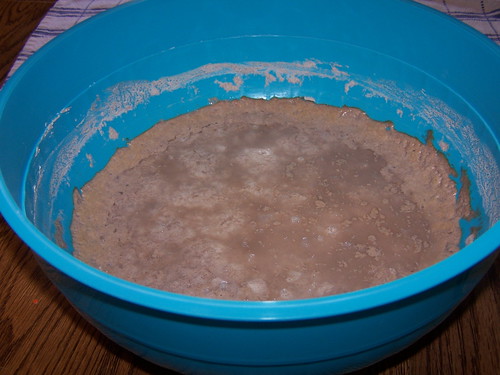
When you wake up in the morning, you will probably see a 3 layered starter (if you have a clear container that is!). The bottom layer will be the tallest layer consisting of injera starter. The middle layer will be a very thin layer of liquid. And the top layer will be another layer of injera starter. This is good. If yours doesn't look like this, just keep going anyway because even if it doesn't turn out good, you'll learn from the experimenting process.

You will need to use a blender for this step. My Ethiopian friend who taught me to make injera said that it must be a blender. She has tried using a food processor and her injera didn't work. So, I've done as she said, and I've been successful.

You will need to gently stir up the injera starter. After you've stirred it, SAVE 1 OR 2 CUPS FOR THE NEXT TIME YOU MAKE INJERA!!!!!!!!!!!!!!!!!!!!!!!!!!!

You will be most upset if you accidentally use all of your starter and don't have any left! Trust me on this one. I'm speaking from personal experience! :) Store the starter in the refrigerator up to a month at a time. It's probably better to pull it out once a week and give it a regular feeding of water and flour, but you can get by with a month. It just might take 2-3 feedings to get it built back up in strength before making injera if you wait that long.

1 cup at a time, you need to blend the starter in the blender. The goal is to get rid of the gritty feel. Alternate settings on the blender. After maybe a minute, rub some of the starter between your fingers. If it feels smooth with only a very slight amount of grit, then it's done. Pour the starter into a clean plastic container after you've blended it up.

Next, you need 3 cups of self-rising flour. Add warm water to it and mix with your hand. The consistency needs to be soupy. After you do this, you'll need to blend it up just like you did the teff starter. It doesn't take as long in the blender though. The goal of this step is to get the mixture smooth and free of lumps of flour. Just as with the teff starter, you'll want to blend it up about 1 cup at a time. When finished, pour it into the container along with the teff starter.

Next, use your hand to thoroughly mix the two mixtures together. The final consistency needs to be thin and watery and soupy. Again, the test is to dip your hand in. If the mixture slides off quickly and leaves a thin residue, the consistency is right. If the consistency doesn't seem right, you can thoroughly mix in more water a little bit at a time until it is right.

Cover it with a lid and let it sit on the counter. Check on it every hour or so. You will notice that the mixture will begin to rise. This is good. In fact, the more it rises, the better the injera will be. Once the rising subsides and the mixture begins to settle back down, put it in the refrigerator for 45 minutes- 1 hour.

Step 3 (The Afternoon)

Click here for a video showing the cooking step

By the time you put it in the refrigerator, it will be the afternoon (unless you sleep in really late, in which case, your injera probably won't work because too much time will have passed between the steps!)

After the mixture has been in the refrigerator for about 1 hour, it is ready to cook!

Unfortunately, the video I made of the first 3 injeras that I cooked was too long for youtube.com by about 30 seconds! So, I am not able to show the consistency of the injera batter. It should be thin and watery. Just a little thicker than batter for crepes. If it's too thick, it doesn't spread out on the mitad very good.

Heat up your mitad to the highest setting, just slightly above 500 degrees. Each mitad is slightly different, depending on age, heating coil, etc. So you may need to experiment with the temperature. On my Ethiopian friend Abeba's mitad, she uses about 475 degree heat. I have to use 500 degree heat. We have the exact same mitad, but they were purchased at different times.

Once the mitad is good and hot (this takes a little while), you need to sprinkle about 1/2-1 tsp. salt on the surface. Using a damp, clean cloth, rub the salt into the mitad in a circular motion. You must do this after every few injeras. It aids in achieving the ain (bubbles) in the injera. But salt isn't good for the Teflon coating, so try to only use it as needed so that your mitad will last longer. NEVER use oil on the surface!!!!! I read that oil permanently adheres to and changes the properties in the Teflon. I use my mitad only for injera. Never anything else.

Once you have salted the mitad, gently stir the injera batter to get it mixed up and pour approximately 1 cup of the starter onto the hot mitad. In Ethiopia, injera is made by pouring in concentric circles working toward the middle. In America, this method does not work. It produces a very thick injera. Perhaps this has to do with altitude? I don't really know. But I do know what works!

Your pour the starter onto the mitad then pick it up and shake it gently in order to get the starter spread out over the entire surface of the mitad. You may notice the ain starting to appear. This is good. Cover it with the lid. Once steam starts pouring out of the small vent in the mitad, lift the lid just a little to check on the injera. If it has started to lift up a little bit around the edges, it is ready to come off.

If you cook injera too long, it becomes soggy and gummy, as the steam is trapped inside.

Removing the injera is tricky. Well, it's been tricky for me! The first time I dropped half of them into a gummy pile! I use a sufid (Actually, it's smaller than a suffid. I don't remember what it's called) that I bought in Ethiopia. Basically, you need to find something that is the size of the mitad (16 inches) and flat. Using your finger, you gently lift one edge and quickly slide the suffid underneath the injera. Set it down on the sheet, still on the suffid.

The injera will look gummy and not good when you first take it off. As it cools, it becomes the nice spongy consistency of injera.

Often, the first injera won't be good. It might be gummy or lacking in ain. Often though, the rest will turn out okay. So, if the first one isn't good, try another one.

Begin cooking the next injera. After you have the lid on, then go back and remove the injera from the suffid. Lay it on the sheet. Note: If you stack the injeras on top of each other right away, they will stick together and you won't be able to separate them. If you let them cool on a sheet first, then stack them, they will peel apart when you're ready to use them.

Variations:

Now, I will address the color and taste of injera. Most reseraunts that I have eaten at in America serve a whiter injera. However, as with American bread, darker bread usually contains more nutrients. The same is true of darker teff and darker injera. To make lighter injera you can use ivory teff which is usually the same price as regular teff. It's usually specified that it is ivory. Another way is to experiment with the ratio of teff to other kinds of flour. I have not tried this recipe yet, but an Ethiopian woman who sells injera for a living told me that she uses teff, barley, and self-rising all in equal proportions. Experiment. And let me know what you come up with! Just remember that if you use too much teff, the injera won't have enough ain in it.

Conclusion

So, this has been a lot of information. As with anything, when you've done it a few times, it's easy to forget steps in the process, or information that wasn't so obvious at first. So if you get started and run into a question that I haven't addressed, please feel free to email me with your questions. moore4jesus1@juno.com

Good luck! :)


Monday, January 22, 2007

Yesus On The Streets

Tuesday was our fourth day in Ethiopia and I couldn't even allow myself to think about the fact that tomorrow I would have to say goodbye to my children without knowing when I would be able to come back to take them home. Despite the sadness that was starting to overwhelm my heart, it was an incredible day. Before I get to my kids though, I'll share about how Yesus On The Streets went.

Avery had asked one of the hotel's receptionists if she could help us to take the Yesus On The Streets bags to her church. She came up to our room to see exactly what we had to give away and when she saw all of the bags she was completely astounded that we were giving it all away. She just kept asking us why we were doing this. We told her that when we had told the people in America about the people in Ethiopia that they wanted to help. We explained that each photo was of the person who had made the bag. She had tears in her eyes as she looked at them. We told her that she could have one and she was overwhelmed at this. She looked through the bags to choose one like a little kid on Christmas morning. As we saw how deeply she was touched by the gift, we had the idea to allow the hotel employees to have them first, then to take the leftovers to the church. You see, we knew that the employees of this hotel, though employed, made very little. Hana (the receptionist) was one of the highest paid employees and even she was overwhelmed at the prospect of choosing a bag filled with makeup, jewelery, medicine. When we asked Hana if this would be okay she exclaimed with tears, "Nothing...Nothing like this has ever happened at this hotel before!"

She had all of the bags carried down to the ground floor where she helped us to lay them all out on a table. We told her to allow everybody to take one for themselves and one for their kids as well. We asked her to take charge of the distribution and to make sure that everybody understood that though we were the ones who had brought the bags that they were not really from us. We told her to make sure the employees understood that the people in the photos had made the bags because they understood how much God loves the people of Ethiopia. We put a little card inside each bag that said, "Exhiabihair kananta gar yehun" (God is with people everywhere---this is the best translation I can offer. Abeba wrote it for me).

As the maids, cooks, wash people, waitresses, etc. began to file into the room to see the gifts that the ferinj had brought, the scene was truly sacred. We had our camera with us, yet we couldn't bring ourselves to take a single picture. It felt like we would have been completely intruding on a very private moment of joy. As much as we wanted everybody in America to see how much their gifts had touched the recipients, we just couldn't do it. People began excitedly shouting at each other in Amharic as they would hold up their bags to display the incredible treasures contained within. Hana was explaining to them how to use the various medicines and they were in awe that taking just two advil would make their fever go away. Or that giving their kids Pepto Bismal would make their diarrhea stop. One maid held up a size 3T boy's T-shirt and exclaimed to another, "For your baby!" They kept coming up to us gushing with gratitude and we just kept pointing up and saying, "Amasegenalo Yesus! (Thank you Jesus). They would look up toward Heaven and say with great emotion, "Amasegenalo Yesus!"

One maid seemed to be acting quite selfishly, as she was hoarding bags in a corner and chasing away anybody who tried to go near them. Hana was handling things though, so we just stepped back feeling confident that she would do what was right. Later, we saw this same maid congregating on the 3rd floor with all of the maids and wash people who hadn't been able to get down to the ground floor in time to choose a bag. The "selfish" maid had been thinking of her coworkers the entire time! She gave all of the bags away.

These are good, hardworking people who were created in God's image. And yet because they were born in a 3rd world nation instead of America, life is so hard for them. And despite their difficult circumstances, we saw such contentment and happiness on the faces of the people we came into contact with during our short stay in Addis.

This project didn't turn out anything like we expected, but we know that it turned out exactly as God intended it. To all of my readers who sent bags, please know that your gift gave these people hope that God has seen them and cared for them. I wish you all could have been there to see with your own eyes.

Now, since I've received many emails from people who would like to do this project, this is what we learned. This particular project is not something that will work for street people. I've already talked about this with a few people who seem to know a lot more than me, as they kind of already knew this. But, some of us seem to have to learn these things the hard way! (US!). Anyway, even though this didn't reach the street people, this really showed God's tangible love to many employed Ethiopians who though they have an income, still struggle just to survive in an unfair world. I would absolutely recommend this project to people looking to reach this group of people. However, we have found out just how imperative it is to have a person, church, or organization in Ethiopia that can assist in the distribution. God, (because He knows Avery and me so well!) was good enough to provide Hana to us. But I wouldn't do this again without a solid plan in place ahead of time.

I forgot who sent me this idea, but one of my readers shared that they bought ALOT of bread and drove around in a taxi for 2 hours distributing it to the poor on the streets. She said that she was amazed at the selflessness of those who wanted the bread to be given to those who hadn't eaten, as they had already had bread that day. I don't know if we'll have time when we go back to Ethiopia to bring Yosef and Mihret home, but if we do, this is something we'd like to do.

I'd love to hear from anybody else who has done a successful project like this. The more of us who are working toward helping those who are less fortunate than the majority of Americans, the better place this world will be.

Wednesday, November 22, 2006

Injera- Perfect Starter Finally Achieved!

I have had a very nice injera starter going for several months now and it produces pretty decent injera. Not perfect yet. I think I need a fire pit, but Avery said no. Something about city ordinances????? But my starter does produce pretty good injera most of the time.

Because I know I'm not the only emaye (mommy) out there who knows nothing about sourdough starters, I'm going to explain this really simply. So if you already know about sourdough, don't feel insulted! Lots of us are clueless!

YOU WILL NEED LOTS OF PATIENCE TO MAKE THIS WORK!!!!!

What You Will Need:
One 1-gallon plastic, ceramic, or glass container with a lid
flour (white unbleached works great. Others are fine)
water

Day 1

Wash everything that will come into contact with the starter so that you don't have any little unwanted bacteria trying to get in and mess up your starter!

Mix together:
4 cups lukewarm water, 78 degrees- Water that's too hot will kill your starter.
3 3/4 cups flour

You can mix using a spatula or your hands. I recommend using your hands so that you can get to "know" your starter. This will make sense to you much later after you've experimented a lot.

The point of the starter is for the natural yeasts and bacteria in the air to form a sybiotic relationship with each other in the starter, thus keeping it alive. In order to give your starter a little help, you can use 1 pound pesticide free red or black grapes, a couple of potatoes cut up into smaller pieces, or a couple of fresh peaches. You tie the fruit or potatoes up into a cheese cloth and put the cheesecloth into the starter. If it's a juicy fruit, squeeze the cheese cloth to release the juices into the starter. When I made my starter a few months ago, I used cut up potatoes. This is supposedly not necesary, but I don't know. I figured I needed all the help I could get!

Let your starter sit on your counter covered with a lid.

Day 2

Do nothing. Keep starter on counter covered with lid.

Day 3

Do nothing. Keep starter on counter covered with lid.

Some bubbles may have started to form in the starter. This is good. If it's really frothy, this is good too. The cheese cloth may have inflated with gas and floated to the top. This is good. If you smell it, it should smell "yeasty" like fresh baking bread. This is good. If it looks gross, this is good too. If it's moldy, this is NOT good. Remove the mold as soon as you see it using a spoon. As long as you remove the mold, this is good!

Day 4

Add 1 cup flour and 1 cup warm water.

Mix with your hands. Cover with lid and keep it on the counter.

You can technically make injera at this point, but it's not as easy or as tasty as if will be if you wait a little longer.

The starter will start to smell like alcohol soon. This is good.

Days 5,6,7,8,9

Do nothing. Let it sit on the counter. If you see mold, remove it right away. Then, only if there was mold, you can add 1 cup warm water and 1 cup flour. Stir.

Unless there was mold, you don't need to stir the starter. Just leave it alone. At some point, the alcohol smell will be replaced by a nice yeasty smell again. This is good.

Day 10

You will begin your starter's regular feedings on Day 10. Remove cheese cloth and throw away. Stir your starter very well. Set aside 2 cups of the starter. Throw the rest away. Put the starter back into your 1 gallon container. But clean the container first. For the best injera results, feed your starter 3 times a day. Feeding this often makes it so that you have lots of ain ("eyes" - this is what Ethiopians call the bubbles in the injera).

Add:
1 cup warm water
1 1/4 cups flour

Stir thoroughly with hands. Put lid back on.

I try to space out my three feedings. Ideally, it would be fed every 8 hours. But you have to sleep at some point! I feed my injera first thing in the morning, again in the early afternoon, and again right before I go to bed. Space the three feedings out the best you can given your daily schedule.

For feeding #2, add:
2 cups water
2 1/2 cups flour

By the time I need to do feeding #3, I usually throw away all but 2 cups of the starter and start all over again with the feeding amounts. In other words, for each feeding, you double the amount of flour and water that you used the previous time. But, as you'll soon figure out, doing this will create A LOT of starter! So, once you throw away all but two cups, you'll start again with adding 1 cup water and 1 1/4 cups flour.

Days 11, 12, 13, 14, 15

Continue with the 3 times a day feeding schedule. By Day 15, the starter might be ready for injera. Mine was not. Mine took almost three weeks before it was ready to make nice injera. The way you know it's ready is to try it. If it makes injera with lots of bubbles, it's ready. If not, keep feeding it a few more days and try again.

Day 15 And Beyond

As long as your starter isn't in the refrigerater, you need to feed it regularly. I have found that feeding it just once or twice a day will keep it from dying. But any fewer than three feedings each day produces injera with not so many bubbles for me. Because the amount of wild yeast in your house is not the same as my house, each person's results will vary slightly. Temperature also has an affect on how quickly the starter develops. Once your starter is very strong and healthy you can put it in the refrigerater.

Refrigeration

You should pull your starter out of the refrigerater, let it sit until it's room temperature, and give it 1-3 feedings about once a week. It is possible to get away with once a month, but you're risking letting it die if you wait so long. Mine is at the one month point right now. So, when I pull it out to feed it today, I sincerely hope it's not dead!

Converting Your Starter To A Teff Starter

Once your starter is very strong and consistently bubbly, you can then convert it to a teff starter in order to obtain the proper sour teff flavor of injera. This part is easy. You just feed it as detailed above. It only takes 2-3 feedings before the teff has become the dominant flavor in the injera.

Saturday, September 30, 2006

30 Days- Final Day!!!

I suppose that technically, I shouldn't go to the store until tomorrow. However, I am going to Walmart today. I'm going to buy luxurious items such as dish soap, toilet paper, bleach, plastic wrap, eggs, bread, and disposable razors! Never before have I considered such things to be luxuries, but indeed, my life is full of luxury for which I have never been so grateful. So, what has fasting from consumerism for 30 days done in my heart?

It's brought a much deeper awareness of my ability to make a difference. It's brought a much deeper revelation of my responsibility to make a difference. It's brought an awe of God's love for people that I've not previously experienced...A passion that has always been in my heart has been ignited...no, it was already ignited...the fire has been doused with gasoline and pumped full of oxygen...

Let me begin by saying that I hate fundraising with a passion. After only 3 days of school, Kaitlyn brought home a catalogue full of overpriced chocolates in cutsie little tins that she is expected to sell to all of the important people in her life. She's only 6!!! I think she's too young to be an aspiring saleswoman! So, I reiterate: I hate fundraising with a passion!

When we started our adoption, we knew we couldn't afford it or even hope to come close. We knew we couldn't take out a loan, as we wouldn't be able to afford to pay it back! So, we had to turn to our community for help. We sent out hundreds of support letters asking for people to sponsor our adoption. We sold half of what was in our house and convinced others to contribute to a huge yardsale. We sold pins and patches at biker events. The youth in our church had a car wash. One of our close friends, a French teacher, had his French Club raise money for our adoption. We were awarded grants. We went to area churches and gave a presentation about our adoption and how it reflects God's heart for people. We became professional fundraisers! And as much as I hate fundraising, looking back, I wouldn't have done it any other way. Because of the fact that we were financially unable, the door was opened for many others to come along with us on this amazing journey. Because of our need, we talked to so many people about adoption. As much as we need and appreciate all of the money we received, the most rewarding part is when other people have started to understand that as much as we love our Ethiopian children and have been willing to fight hard for them, God loves them so much more. Our adoption is such a tangible image of God's love and His willingness to give up everything and fight for us, His children.

So, what does this have to do with 30 Days of Nothing? Well, I was willing to do a fundraising campaign for our adoption, afterall, these are my children! But, I certainly don't want to have to do it again because I still hate fundraising with a passion! But, during this 30 Days, the question for me has become, "What are my primary passions? What are the things that make my heart skip a beat to the point that I am willing to do something I hate in order to achieve my greater passion?"

The answer is Konjo Kids. Right now, Konjo Kids is just a pipe-dream that is beginning to take on some form in our hearts. But, it's going to require lots of money, which is probably the biggest reason for why I've been resistant to the idea. In fact, at the very beginning of our adoption, I was talking with a woman who runs an adoption grant organization in North Carolina. I told her that I really admire what she does but that I really just wanted to adopt my kids and return to life as normal, business as usual, and that I really hoped God didn't ask me to do anything further with adoption, as He had asked of her. She shared with me that she too felt that way during her adoption, yet now she and her husband are doing adoption grants! In that moment, I just knew deep inside that God was going to ask something more of our family. More than I really wanted to give. Because I like my life. It's pretty ordinary, which I really like. My life's never been very risky by my standards. But, I suppose there's something about adopting 2 kids that you don't even know that ignites a risk-taking streak inside of you anyway!

So, following this 30 Days of Nothing, I am in a place where I am taking ownership of my responsibility to make a difference. Adopting two kids out of 5 Million orphans that live in Ethiopia alone isn't enough. It's a start, but it's not enough. I can't save every child. But I can do more. I can't sit back and live in my American luxury anymore. I must make a difference. Not because I'm guilty, but because it's the right, human thing to do. I must make a difference because God is enabling my heart to love people the way He does. I'm seeing the impoverished the way He does. They are full of hope and promise. God wants them to have a hope and a future. But ordinary housewives, librarians, teachers, lawyers, computer techs, doctors, artists, maintenance men, postal workers, 1st graders, preschoolers, ALL need to be willing to be the hands and feet of Jesus to them. The invitation has already been extended to us by God to feed the hungry, clothe the poor, fight for justice for the oppressed. Our only responsibility is to respond and obey and do what the Father is doing. So, exactly one year after we decided to take the risk of accepting a referral for kids that we couldn't pay for, we once again have decided to take the risk of not returning to our "business as usual" lifestyle by committing to doing the stuff that God is passionate about for the people that He is crazy in love with. As Konjo Kids takes on some more definitive form and function, details will be posted.

Monday, September 18, 2006

30 Days- Day 18

Avery went to the store last night. The list of items he came home with:
bread
peanut butter
ketchup
sandwich meat and cheese
mayonaise

He went for bread and peanut butter and made an executive decision regarding everything else. I don't really have any feelings about ketchup one way or the other normally, but I've absolutely been dying for some this past week! Anything to give the potatoes a different flavor!

It's funny, but I've realized that in addition to the blessing of an abundance of food, I am so blessed with the sheer amount of variety that is at my disposal here in America! We've been eating a lot of rice, and while you can jazz it up, there's only so much you can do and I'm so sick and tired of rice! I've never been so appreciative of the fact that I can eat different foods from all around the world right here in America. Less than two weeks to go...

On Saturday we washed our clothes in a stream, which we walked about 1 mile to get to. It was actually a lot of fun. I think the kids liked it. But they were quite tired once we got home and left their bags with their clothes outside instead of hanging them up to dry. So, on Sunday morning, Lucas wanted to wear his "nice clean sweater" to church, meaning the one he washed in the stream. He asked Kaitlyn to help him find it. They came to me and asked if I knew where it was. They were astonished that Mommy hadn't dried their clothes for them!


And it wouldn't be the same without the worms, bugs, and frogs! Isn't that part of the joy of having a boy (and often girls too!)!?:)


Tuesday, September 05, 2006

30 Days of Nothing- Day 5

Before I go into the 30 Days of Nothing, I'd like to say that today marks the beginning of week #2 of school. I definitely got out of bed in time to get Kaitlyn ready without too many problems. Except for the fact that two hours wouldn't have been enough time today! Tolo na ebakesh (hurry up please) wasn't in her vocabulary today. Rough morning, but she made it in one piece. Now I'm left with Lucas. Sweet faces like this are what makes it all worth it- burakaeyae:


Now, about this 30 Days of Nothing...

Confession #1:

I went to the store last night. We were out of shampoo and there are still 25 days left. Enough said! I did resist the urge to buy pretty hair clips for Kaitlyn!

30 Realizations for 30 Days of Nothing:

1. Having spent only $98 on groceries for our family of four for the entire month of September, I still haven't come even remotely close to living like much of the world lives.

2. Firstly, I actually had $98 to spend on groceries.

3. My cupboards are full.

4. In fact, they're overflowing with food.

5. Despite the fact that there isn't going to be a whole lot of variety this month, I have enough spices in my cupboard that we can have a different flavor of rice every night without having to repeat anything.

6. I have enough rice to last for an entire month.

7. My kids can eat as much as they want.

8. There is no need in my house for rationing our food.

9. I have hot running water right in my kitchen.

10. I have a kitchen in my house.

11. I have a house.

12.I have a stove in my kitchen where I cook the food that I just pulled out of my refrigerater.

13. I have a refrigerater.

14. It's full of food.

15. I can't count the times I've had the audacity to complain that I couldn't find anything to eat, which really meant that out of all the food in my house, none of it appealed at the moment.

16. If we did run out of food and money, we wouldn't have to be hungry.

17. We could turn to our church for help.

18. We would go "shopping" in their food pantry.

19. My kids wouldn't have to be hungry.

20. I wouldn't have to go hungry for the sake of feeding my kids.

21. I have never had to make such a choice.

22. And if I did make such a choice, it would probably be due to the pride that would keep me suffering in silence rather than an actual need for that kind of sacrifice.

23. I have thrown away enough injera batter to feed my Ethioian kids' entire orphanage a high- protein breakfast for a month.

24. If I ask God to open my eyes to the reality of my wealth and my waste, He will do it.

25. God isn't helping me to see this so that I can feel guilty.

26. God doesn't motivate people by making them feel guilty.

27. God wants me to recognize my waste so that I can reign it in and steward our resources better.

28. Our wealth isn't for us alone.

29. God has blessed us as Americans so that we can bless others.

30. Saving money so that a family in Kenya can have a bicycle for making a living is just the tip of the iceberg for our family...

Burakaeyae (My Blessings) thus far:

1. Avery designed a logo for Bikers for Christ several years ago. This weekend, we discovered that it has been used on a T-shirt, which we could have purchased at the BFC retreat. But, that definitely would have broken our fast from consumerism. Later in the evening, knowing nothing about our 30 Days of Nothing, Pastor Fred Z, founder of BFC, pulled Avery aside and gave him a T-shirt for him and one for me too! I've come to know God as my Father and He is so lavish with me. Certainly, a T-shirt isn't exactly a need for me, as I have plenty of clothes. But our Father wanted the pleasure of watching His kids enjoy a little token of His affections.

2. I fed my kids donughts for supper at the BFC retreat. I didn't have to do that though. God already had it taken care of. We enjoyed fried chicken and salad, compliments of Stillwater Lodge. We didn't have to eat donughts just because they were there. God gave us something much better. Next time I will trust Him more. This made me realize that I've been worried about the fact that I'm soon going to have four kids, yet I drive a sub-compact car! Definitely a problem, especially since three of them are still in car seats. I've tried to figure out where a larger vehicle would come from. How will we pay for it? We've already spent $4,200 on fostercare for our kids in Ethopia, far more than we ever anticipated spending. Money that we had earmarked for a van. Our "van money" is almost completely gone now. Now I know that if God cares enough about us to make sure we had frivilous T-shirts and fried chicken despite the fact that we weren't hungry, then He will surely see to it that we have a vehicle where we can drive our kids around safely. Trust...


3. Generic Saltines and Stale popcorn out of the trashcan. That's right, this was a blessing to me yesterday! Supper last night was cooked by some very good friends who honored us by inviting us to supper and pampering us and serving us. I didn't have to do a thing. It was soooooo nice! They wanted to love us by taking care of us. Not only that, but aware that we're doing this 30 Days of Nothing, they sent us home with three pounds of venison (deer meat for those of you who have never hunted or are opposed to hunting!). As we were leaving, Amy opened her cupboards and started looking for other things she could send us home with. Hence, the Saltines and stale popcorn (for feeding neighborhood ducks- I can't afford to be feeding them bread this month!) .

Friday, August 11, 2006

Injera-what I Learned This Week

Injera- I've decided this flat sourdough Ethiopian bread is more of an artform than just a simple recipe! Last week I came up with a pretty decent injera by improvising with some seltzer water for extra ain (what Ethiopians call the bubbles- it literally means "eyes"). This week though, after consulting several sources regarding the science of breadmaking, I have come up with the perfect injera. Well, it seems perfect to me based on my experiences in Ethipian restaraunts in America. Avery, who just spent a week in Ethiopia also said that it tasted and felt just right. The only thing that's not quite right is the color. My injera is a little darker than most of what I and Avery have seen. I have absolutely no explanation for that. Well, actually, I have a theory about the kind of teff I used. I'll explain later. I was counting on my very dear friend, Rosa, to critique my cooking this weekend. Rosa is originally from Ethiopia, so I figured she'd know better than anyone if it was right! Unfortunately, her plans changed at the last minute, so I have nobody to critique the authenticity of my injera. Anyway, I am going to share in excruciating detail all of the things I learned about injera this week. If you have no interest in making injera, you probably ought to stop reading now because this post is probably going to get pretty boring. If you want to cut right to the chase, you can skip all the way to the second to the last paragraph where I start with "So, in a nutshell..." Otherwise, proceed with reading my ramblings about injera!

I am definitely not Betty Crocker, so perhaps the things I learned this week will be painfully obvious to some of you who are reading this! However, I know that there are others out there who have the same culinary expertise that I was born with, so I'm going to explain every little thing I learned. If any of my readers have anything to add, I sincerely hope you will post a public comment so that everyone else can learn from you too!

Okay, here we go. First, If you've ever made sourdough bread from a starter, you might know more than you think about injera! I've tried countless times that recipe that we've all seen on the internet about mixing teff and water and letting it sit for 3 days and supposedly, just like magic, the injera will be perfect. Well, in all of my trying, the magic just never happened for me! The finished product has always been either gummy and/or completely void of ain. However, after reading up on it, I understand in theory why and how that ought to work. I'll explain.

Again, this works in theory. I have not had success with this method yet, but in theory, the science behind this is correct. As with any artform, I'm sure this could be perfected with lots of practice and experimenting. You see, combining the flour (teff in the case of injera) with water is the first step in creating a starter. The starter is the first, crucial element in making injera. Without a proper starter, it will not be possible to achieve the same sour taste combined with the soft, airy quality that is characteristic of good injera. To make the starter, you combine 3 3/4 cups flour with 4 cups warm water. The water must be warm, 105 degrees is ideal. Warm tapwater is fine to use. This mixture of flour and water will naturally attract wild yeasts and beneficial bacteria over the next several days. I am going to once again try this method that does not include using commercial yeasts next week. If I ever get it to really work well, I'll share.

Thus far, I have not gotten injera to work without commercial yeast. I did however, produce some near perfect injera this week using commercial yeast. Here is what I did:

1. I experimented and realized that following a recipe precisely doesn't guarantee successful results. I realized that injera is more about the smell and appearance than about the recipe.

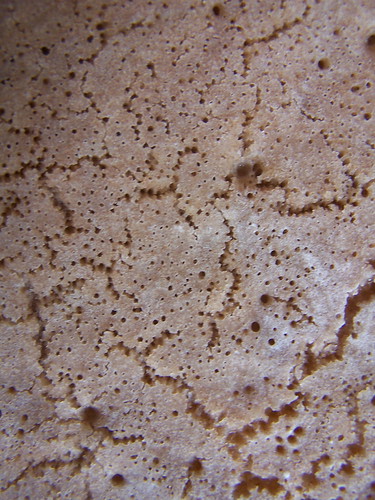
Injera needs to ferment. That's how it gets the sour taste. Since I couldn't get it to work by relying on natural yeasts, I used dry commercial instant yeast instead. As the dough ferments, the sour taste develops and the fermenting action causes carbondioxide bubbles to build up and cling to the gluten in the teff. When the injera is cooked, the heat causes the carbondioxide gasses to escape, hence the ain, or bubbles. If there's not enough yeast, the taste will be right, but the bubbles won't be there.

That's what my problem has been: the taste is right, but the texture isn't. After consulting with a couple of women this week who know far more about baking bread than I do, I concluded that adding some yeast to my fermenting teff and water starter might help. It indeed did help.

So, on the first day, I started with teff and warm water. The consistency should look like pancake batter (when you make thin pancakes, not big, fat, fluffy ones). I used about 3 3/4 c. teff and 4 c. warm water. You need to cover the container tightly so that the fermentation gasses will be trapped inside. I made mine in an ice-cream pail, which is working quite well. If you cover it with plastic wrap, this allows you to see what's happening to the starter without taking the lid off and releasing the gasses. Secure it with a rubber band though because as the gasses build up, it can cause even a tight lid to blow off the top of the container. Once I became familiar with the injera batter, I just started using the lid because I no longer had such a need to see it all the time to make sure it was right. Also, don't use a metal container. Use either glass or plastic. I have no idea why (like I said, I'm not Betty Crocker), but every book and baker I've talked to has said that, so I thought I'd just follow their advice!

You can stir the teff and water with a spoon, but I recommend using your hands for a couple of reasons. One, you can get it mixed a little better, as you can squeeze the lumps with your fingers. Two, there are natural yeasts and good bacteria on your hands, both of which are good for your starter. Three, it's good to know what the starter feels like, sort of like getting to "know" the bread. I'm not suggesting that you form an emotional bond with your bread, simply that you become very familiar with it, as this helps in developing good inejra!

For three complete days, do NOTHING at all. Don't take the lid off and don't stir it. It will start to look really gross. Perhaps slimy, perhaps black and watery, perhaps yellowish and watery. Or it may seem to become alive and grow large lumps throughout it that poke up out of the water. On day 2 or 3 it should start to bubble. This means that you'll see little bubbles coming up. If you move the container a little, this will release some of the bubbles. Try not to move it because you want the bubbles to be in there, but feel free to move it a little just to see what's happening to the starter. Sometimes, it may bubble a lot and become frothy. All of these are good. It will smell "yeasty" or like bread dough, but also may smell bad like...well... like rotting flour?! Again, the smell is good. I actually enjoy the smell, but my kids definitely do not!

The starter should be kept warm, idealy at 72-75 degrees. Basically, keep it at room temperature. If it's in a room that's too cold, the yeast won't do it's job. If it's too hot, you can kill it. Literally, the starter is alive. Yeast is a living organism. You have to take good care of it so it doesn't die. A friend told me that if you turn you oven on to 400 degrees and leave it on for one minute that you can then turn it off and stick the starter inside. This is the perfect temperature to help the yeast do it's thing. I put my bucket on top of a baking sheet covered with a towel so that I don't risk melting the bucket on the oven rack. Again, make sure it's not too hot in the oven though or you'll just mess it up.

Now, on day 4, the injera can actually be cooked for a successful result in theory. For me, this has not happened yet though. For me, there just hasn't been enough ain without using yeast. I know that the yeast consumes the sugars in the flour and this produces the carbondioxide which clings to the gluten in the flour, which produces the ain. I sort of overcame this problem by adding seltzer water, which gives it instant carbondioxide bubbles. This produces a passable injera, but this week I decided to find a real solution instead of this quick fix.

So, here's what I did. On day 4, I added commercial yeast. Now, bread snobs are highly opposed to commercial yeast! This is why I hated to do it. But, I can't argue with the results I had, so I think I'll continue to use commercial yeast. I will continue to try to raise a healthy starter using only the natural yeasts in the air, but at least I can now make decent injera. Here's what I did:

On day 4, when the injera just wasn't working out, I added yeast. I used dry instant yeast. I used 1 tablespoon of yeast for every quart of starter. I had started with a larger batch, so I used 2 tablespoons of dry yeast. You combine that yeast in a bowl with about a teaspoon of sugar and 1/4 cup warm water (105 degrees) out of the tap. This activates the yeast. The yeast starts to "eat" the sugar, which is what activates it. Supposedly, it's not necessary to activate instant yeast. I've tried it both ways though and I had better success with my injera when I activated it first. Perhaps it was a fluke. I don't know.

It takes perhaps 10 minutes to activate. You'll know it's activated when the mixture is sort of frothy or bubbly. At this point, stir the yeast mixture into the injera. Don't worry about the sugar making it sweet and taking away the sour taste. The yeast eats it up and you won't even taste that small amount. Once again cover it tightly. You always keep the starter tightly covered. Keep it warm. It won't be ready immediately, but in an hour or so, it should be ready to try and cook. We'll get to that later though.

You can go through this 4 day process each time you cook injera, each time starting from scratch. But, the way they would do it in Ethiopia, which is also the way that produces a more flavorful injera each time, is to save some of the batter as your starter. Just like when you make "friendship bread" you always save a little bit of batter for the next batch. In theory, you shouldn't have to add more yeast and the yeast in the starter will continue to grow and stay alive. I'm still working on this part. In order to keep it alive, you have to feed it. If you don't feed it, it will die and you'll end up with no ain in your injera. If you start making injera with no ain, you know your yeast has died.

To feed the injera, you have to give it a steady diet of more flour and warm water. I actually ran out of teff a couple of days ago and have had to use white flour, but the injera is still nice and sour. So, you can experiment. Maybe it's not necessary to use only teff, which as you know if you've ever made injera, is quite expensive. The "Bread Snobs" whose books I've been reading say you have to feed your starter 3 times a day. Others say you only need to feed it once a day. I tried the lazy approach and my starter died. So perhaps you do need to feed it more often. Like I said, I'm still experimenting!

To know how much to feed it, it takes simple math. If you have 2 cups of starter, you need to add 1 cup of warm water and 1 1/4 cups of flour. For the next feeding, double that amount. You would add 2 cups of warm water and 2 1/2 cups of flour. For the next feeding, double that amount. You get it, I'm sure!

If you know that you can't keep feeding it for some reason, you can put it in the refrigerater for up to a month. The coldness will slow the growing of the yeast enough that the yeast won't starve to death. Keeping it in a cooler room will also slow the yeast so you won't have to feed it as often. A warm room will require more feeding.

My problem is that the starter I currently have isn't very healthy because it seems to die each day. I revive it by adding more yeast, which enables me to create perfect injera. But, that's not the way it's supposed to work. I don't have the answer.

Now, when you cook the injera, the pan matters. I've had the best success using a non-stick teflon coated frying pan. I cook it on med-med high heat. You'll have to experiment with your stove. The injera needs to have airflow over the top of it and also the air has to be able to get to the edges, which gives it access to get up under neath the injera. So, if you pour the batter all the way to the edges of the pan, it will probably not allow enough air to get up underneath it and you won't have any ain. If you make just little tiny injeras in the center of the pan, they'll work out just fine. I bought a family size electric griddle for making injera. This way I can make big injeras. Since the griddle has no sides, it allows air to get to the injera from all sides.

So, in a nutshell, this is what I've learned this week: Injera gets the sour taste from fermenting for a minimum of 3 days. Injera gets bubbles from yeast. The easiest, fastest way to put yeast in it is by using commercial yeast. Don't be afraid to experiment. Add a little yeast, give it a few hours, and if it's still not turning out right, add some more yeast. It is through experimenting that you'll learn how to make injera.

Somebody this week said that I must be a great cook. It made me laugh so hard. I have a handful of dishes that I make really really well. I stick with what I know! Eventually, I'm going to master this injera thing. I like the concept of doing a few things really well rather than doing a bunch of things so-so.

Monday, August 07, 2006

Injera- The Finished Product

Injera day 3 was somewhat successful, I suppose. The finished product doesn't exactly look right, but it's closer than it's been so far. The taste was actually pretty good. It seems that there's a real science to sourdough bread. I've been reading a book about this, and according to the book, it takes 14 days to get your starter batch going. Like I said, I'm determined, so I've already started my starter batch using just teff and water and relying on the natural yeast in the air to be captured by what the book calls this "living organism" called sourdough bread. Avery and I are going to be signing up for an Ethiopian cooking class offered by an Ethiopian restaraunt. Perhaps we'll learn the secret at our class!